
Seven commitments
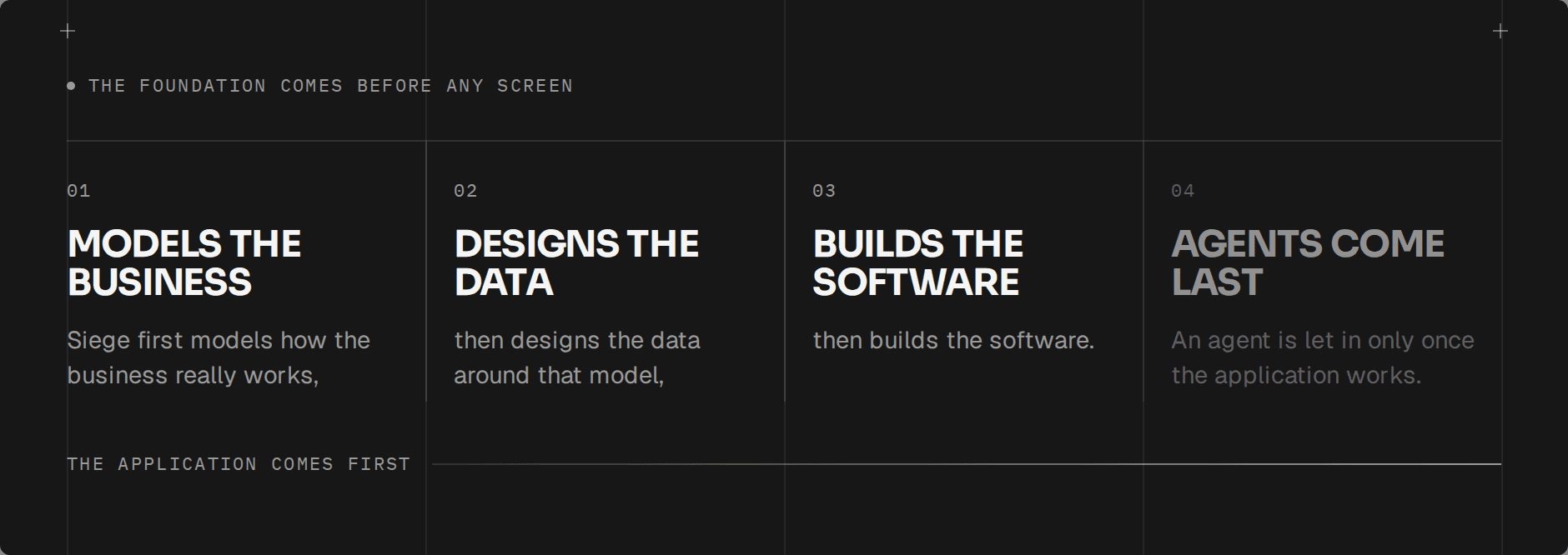
1. The foundation comes before any screen. Siege first models how the business really works, then designs the data around that model, then builds the software. A screen built on an unexamined tangle of tools becomes one more place for the work to live.
2. The data layer and the software are separate. The software can be taken apart and rebuilt any number of times, and none of the data is ever lost or silently changed by it. When data has to move, the move is recorded and reversible. That separation is what makes years of change safe.
3. One model governs everything. The Ontology is the single source of truth for what the business is made of and who may change what. The data model, the permissions and the limits on AI all answer to it. See The Siege Ontology Framework.
4. Every action is controlled. Siege never runs a business system on typed instructions to an AI; asking a model to “build this, and make no mistakes” is how systems fail and how they are left open. Every action, by a person or an agent, is defined before it can happen, permitted to exactly who may take it, checked before it runs, and recorded with who, what, when and on what authority. The application comes first. An agent is let in only once the application works, and it holds keys only to what it is granted, with less room than a person, never more. Siege’s own software runs under the same rules. See AI and agents under control.
5. Anyone the client trusts can check the work. The client’s technical person is welcome before a dollar is spent, and as often as they like after that. Most guarantees in this documentation come with a way to check them, listed on How to verify our work.
6. The knowledge stays inside the client. One of the client’s own people becomes the keeper of the model, checks it against how the business really works, and trains the rest of the team as each part goes live.
7. We say where things stop. Any work still open when a client signs is listed in that client’s agreement, each item with its date. Real data connects only once every item is done and shown to the client’s technical person.
Forward Deployed Engineers
Siege works through Forward Deployed Engineers (FDEs): engineers who work inside the client's business, learn how it really runs, and own the system end to end. They do the part that needs people: asking the right questions, taking the business apart with the people who run it, and putting it back together so it works as a whole. Siege makes the engineering decisions and settles any conflict in the system. The client only answers questions about its own business, and each answer is recorded with who gave it and when.
Everything an FDE builds lives in the client's own repository and Ontology, with documentation and runbooks beside it, so the knowledge is never tied to any individual. FDEs work inside the client's system through Siege's FDE account, in plain view of the client's administrators.
How the engagement works
Stage | What it is |
|---|---|
The Foundation Model engagement | Siege models the business, builds the foundation and the first software on it, and connects real data once the data agreement is signed |
A renewable yearly license | The client's own instance of the Siege platform, renewed each year, including support and updates |
What the client can count on
Commitment | What it means in practice |
|---|---|
Ownership | The client owns its data, its Ontology and its custom code; it licenses the Siege platform its system runs on. See Ownership and continuity. |
No real data before the agreement | Real data connects only after the data agreement is signed and two people have said yes. See Data commitments. |
Changes are reviewable | Every change to the client’s system is recorded with what changed, who made it and when. |
The client’s own accounts | The client’s repository starts clean, and it and the hosting sit in the client’s own accounts. |